In the quiet, rolling hills of Shelby County, Kentucky, the year 1821 began like any other for the Patterson family. They were people of the soil, tied to the rhythms of the seasons and the burgeoning frontier of the young American republic. Yet, by the time the frost of December settled over the Bluegrass State, the family’s foundation would be shattered, leaving a widow to navigate a legal labyrinth and leading to a migration that would redefine their lineage for generations to come.
As family historians, we often find ourselves staring at two dates on a ledger: James Patterson and William Patterson, both gone in 1821. It is a striking coincidence—one that suggests more than just the inevitable march of time. It suggests a shared moment of crisis. Through archival research and the study of frontier medicine, we can now piece together the story of how a single localized epidemic claimed two generations of men and set the stage for the Pattersons’ journey into the heart of Missouri.
The Shadow of the “Bilious Fever”
To understand the deaths of James and William, we must look at the environmental reality of Kentucky in the early 1820s. The frontier was a place of immense beauty but hidden perils. While we often think of “pioneer spirit” in terms of physical labor and expansion, the greatest threat to life was often microscopic. In the summer and autumn of 1821, the Ohio Valley was gripped by a severe outbreak of what was then termed “bilious fever.”
In the medical vernacular of the 19th century, “bilious fever” was a catch-all term. It described an illness characterized by high fever, gastrointestinal distress, and a yellowing of the skin or eyes. Modern epidemiological reconstruction tells us that these were likely fatal strains of either malaria or typhoid. The swampy bottomlands and humid summers created a perfect breeding ground for disease. For the Pattersons, residing in Shelby County, the proximity to waterways meant they were in the direct path of the epidemic’s spread.
“In 1821, the frontier did not distinguish between the strength of the young or the wisdom of the old. It took both, leaving a void where the family’s future once stood.”
James Patterson, the patriarch, was the first to fall. His death earlier in the year marked the end of an era—the loss of the man who had brought the family into Kentucky. But the tragedy was doubled when his son, William, the primary provider for a young family, succumbed shortly thereafter. The records of the Shelby County court provide the grim confirmation: by December 18, 1821, William’s estate was already being liquidated. The speed at which the fever moved through a household was a terrifying hallmark of 19th-century life.
The Probate Crisis and the Widow’s Resolve
The death of a loved one is a personal tragedy; in 1821, it was also a catastrophic legal event. William Patterson died “intestate”—without a modern, legally binding will that could protect his assets from immediate creditors. Under the laws of the time, this triggered an automatic forced liquidation of the estate to ensure that any debts were settled and the remaining value could be partitioned according to rigid statutes.
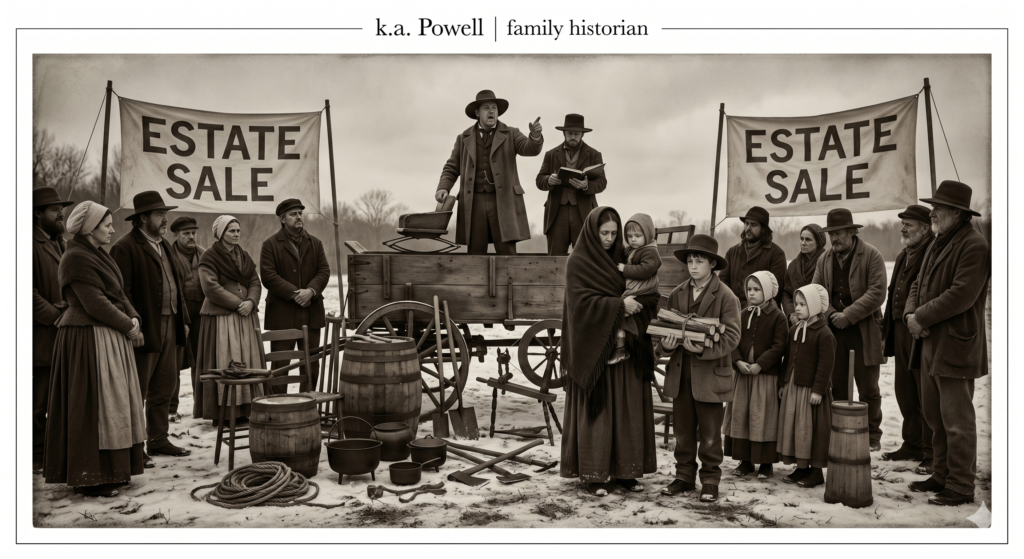
Imagine the scene in December 1821. Mary Catherine Allen, William’s widow, stood in the cold air as an auctioneer called out prices for her own household goods. The estate sale ledger is a heartbreaking inventory of a life dismantled: iron pots, spinning wheels, livestock, and the very tools William used to farm the land. In a display of profound resilience, Mary Catherine was forced to bid against her neighbors to “buy back” the basic necessities required to keep her children fed and clothed. This was not merely a financial transaction; it was a battle for the survival of her family unit.
With the grandfather gone and the father buried, the Pattersons were a family in limbo. Their land in Kentucky was tied up in the messy, slow-moving gears of probate court. For a widow with young children, the prospect of staying in a community where her support system had been decimated by fever was untenable.
The Great Migration to the Boon’s Lick
It was this “dual tragedy” of 1821 that served as the catalyst for the Pattersons’ migration. They were not moving for adventure; they were moving for sanctuary. Mary Catherine looked toward the western horizon, toward the Missouri Territory, which had achieved statehood that very year.
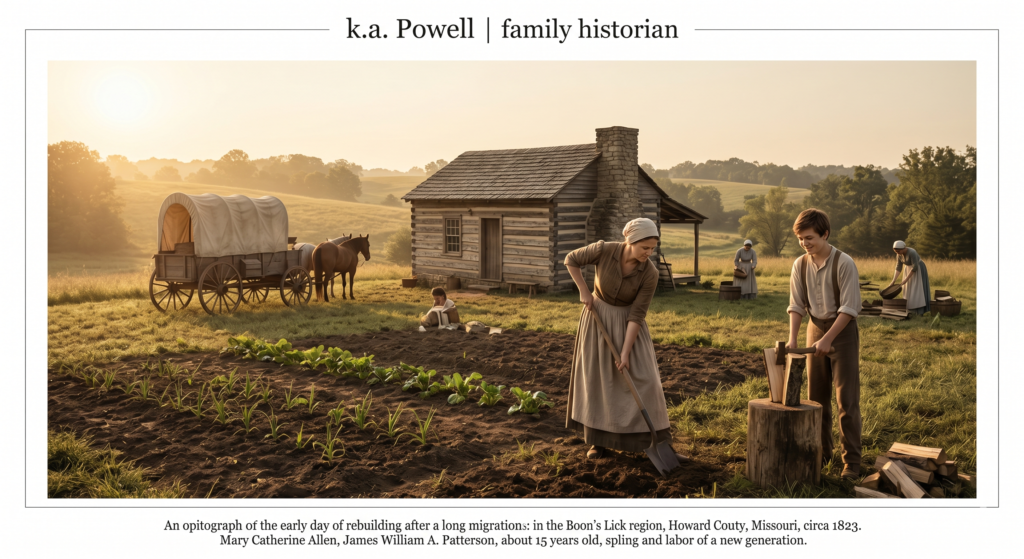
At the center of this move was 13-year-old James William A. Patterson. At an age when most boys were beginning to learn the trades of their fathers, young James William was witnessing the total upheaval of his world. Following the established migration trails, Mary Catherine led her family toward Howard County, Missouri—specifically the region known as the “Boon’s Lick.”
The Boon’s Lick country was a beacon for Kentuckians. Many of Mary Catherine’s extended family members had already made the trek, describing a land of rich, deep soil and burgeoning opportunity. In Howard County, near the towns of Fayette and Glasgow, the Pattersons found a place to root themselves once more. The move was a strategic gamble: by leaving behind the legal entanglements of the Kentucky estate, they could start fresh on the Missouri frontier where land was available and family ties were strong.
Legacy and Lessons in the Soil
When we look back at the life of James William A. Patterson, we see a man who eventually became a pillar of his community in Missouri. But his success was built on the ashes of 1821. The resilience shown by his mother, Mary Catherine, in the face of the Kentucky fever epidemic, is the true origin story of this branch of the Patterson tree.
As researchers, our job is not just to collect names and dates, but to understand the why behind the movement. Why did they leave Kentucky? Why Missouri? The answer lies in the tragic symmetry of 1821. It reminds us that our ancestors’ lives were shaped by forces beyond their control—disease, law, and geography—but their responses to those forces were what allowed us to be here today.
The next time I walk through a cemetery or scroll through a digital ledger, I won’t just see “1821” as a year of death. I will see it as the year the Pattersons refused to let a fever end their story. They chose to move, to build, and to endure. And in the soil of Howard County, that story continues.
Post Disclaimer
Disclaimer This blog is a personal project and is for informational purposes only. It is not intended to serve as a definitive legal or historical record for anyone other than myself.


Leave a Reply