
History is rarely a smooth, continuous line; more often, it is a landscape pieced together from fragments. For family historians, those fragments frequently arrive in the most fragile of vessels—a scrap of lined notebook paper filled with names, or a brittle, yellowed newspaper clipping saved by a relative a century ago. When these two sources collide, they have the power to breathe life into a forgotten ancestor, transforming a mere name on a census page into a flesh-and-blood individual who commanded her own destiny.
Such is the case with Miss Laura Patterson. Through a preserved account of her tragic and untimely death, we are given a rare, vivid window into the life of a late nineteenth- and early twentieth-century woman who defied the traditional societal constraints of her era to become one of Howard County, Missouri’s most successful business minds.
An Uncommon Autonomy
To understand the significance of Laura Patterson’s life, one must understand the geography and social expectations of Howard County, Missouri, during her lifetime. Nestled in the Boon’s Lick region along the Missouri River, Howard County was a landscape deeply tied to agriculture, tradition, and structured family lineages. For a woman born in the mid-nineteenth century, the socially prescribed path was nearly universal: marriage, managing a domestic household, and relying on a husband or male relative to navigate the legal and commercial spheres of public life.
Laura Patterson chose a different path. Described in her community as a “maiden lady” who never married, she achieved a level of financial and operational autonomy that was exceedingly rare for women of her time. Rather than relying on a spouse or handing the reins of her family inheritance to an overseer, Laura took direct command of her livelihood.
The primary records reveal that she managed a massive five-hundred-acre farm located approximately four miles northeast of Fayette. Family research notes hint at an even broader footprint, suggesting connections to three distinct 500-acre tracts. In an era before modern mechanized farming, overseeing an estate of this magnitude required immense administrative skill, a sharp eye for market fluctuations, and a commanding presence in local trade.
The community did not merely tolerate her independence; they respected it. Local accounts explicitly note that Laura was “counted as one of Howard county’s best business women.” She lived alone on her acreage, establishing a solitary, highly disciplined routine that became a familiar marker to those who lived and worked around her.
The Rhythm of the Farm
The daily life of a turn-of-the-century farmer was governed by rigid routines, and Laura’s neighbors knew her by the absolute predictability of her movements. Every morning without fail, she would walk down her lane to retrieve the daily mail. Neighbors like Theo Evans and Charles Lay, passing by the property, were accustomed to seeing her active and working on the land.
This visibility was not just a social convention; in the isolated stretches of rural Missouri, it was a safety net. In a world before telephones were ubiquitous in rural areas, keeping a watchful eye on a neighbor’s smoke rising from a chimney or their presence in the yard was how community members looked out for one another.
On a bright morning, Laura was seen by both Evans and Lay, going about the business of running her estate. It was the last time anyone would see her alive. The very independence that defined her life would also frame the solitary nature of her passing.
Tragedy at the Well
Sometime late that afternoon, Laura stepped out into her yard to perform a mundane, domestic chore: drawing water from the farm’s well. She carried a tea kettle with her, intending to bring water back to the house to prepare a meal or boil tea.
Near the well top stood a concrete step. A loose wooden board, which had originally been used as a mold to shape the concrete when the step was poured, had been left out of place. As Laura approached the well, she tripped over the loose timber.
The fall was sudden and catastrophic. Her body surged forward, her forehead striking the hard corner of the concrete step, while a heavy plank caused severe injuries to her side. Though Coroner Denny Smith and a local physician would later determine that her skull had not been fractured, the combination of the blunt force trauma and internal injuries proved fatal.

Because Laura lived alone on her vast acreage, her sudden absence went unnoticed as darkness fell over Howard County. Saturday morning arrived, and the mail carrier delivered the day’s correspondence to her box at the edge of the property. For the first time in years, the mail sat undisturbed. While Laura’s prompt nature meant that a full mailbox was an immediate red flag, it was not until Sunday afternoon, around four o’clock, that the true gravity of the situation was realized.
Laura’s niece, Miss Mary Berkley, came to visit the farm that Sunday. Walking into the yard, she made the heartbreaking discovery: her aunt’s lifeless body lay atop the well, the tea kettle resting nearby, undisturbed for nearly forty-eight hours. An examination of the house revealed that Laura’s bed had not been slept in since Thursday night, confirming that the tragedy had occurred late Friday afternoon.
The Community Gathers
The news of Laura Patterson’s sudden death traveled fast through Fayette and the surrounding hills of Howard County. Her passing was not just a loss to her immediate family, but a shock to the local agricultural community that had long viewed her as a fixture of stability.
On Tuesday morning, a large crowd gathered for her funeral. The service was preached by Elder E. B. Shively, a prominent minister of the local Christian Church (Disciples of Christ). The large attendance of “many friends” documented in the local press stands as a testament to the high regard in which she was held. She was buried in the soil she had spent a lifetime managing.
Because Laura died unmarried and without direct descendants, her sudden death set off a complex and highly documented legal process. She was survived by a large family network: her two sisters, Mrs. Charles Berkley and Mrs. Strother Jordan, both of Howard County; her brother, James Patterson, who had migrated west to Oklahoma; her nephew, Jesse Patterson; and her nieces, Mary Berkley and Mrs. Harry White.
Tracking the Paper Trail
For the family historian, the story of Laura Patterson does not end with her funeral; it begins there. Because she was an unmarried woman of substantial means who died suddenly, her passing left behind an extensive legal paper trail that provides a masterclass in regional genealogical research. When an individual dies intestate (without a will) while owning hundreds of acres of land, the county probate court must step in to ensure the estate is legally broken down and distributed to the surviving heirs.
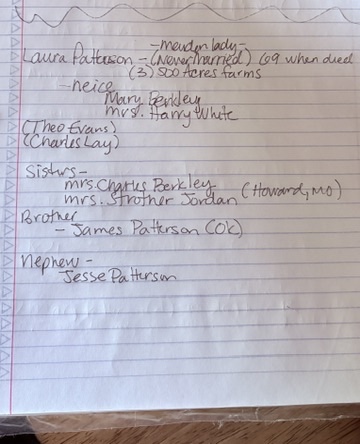
The search for Laura’s official records takes us directly to the heart of Howard County’s archival repositories. The key to unlocking the definitive timeline of her life rests on several specific record groups:
-
The Probate Files: Because there was no spouse or child to automatically inherit the 500-acre farm, the Howard County Probate Court would have appointed an administrator—likely a brother-in-law like Charles Berkley or Strother Jordan, or her brother James Patterson—to oversee the estate. These files contain a complete, line-by-line inventory of her personal property. They list everything from her livestock and farming equipment to the very tea kettle found near the well.
-
Land Deeds and Plat Maps: To verify the family note regarding “(3) 500 Acres farms,” researchers must consult the Howard County Recorder of Deeds. By tracking the deed transactions under the Patterson name northeast of Fayette, we can determine whether Laura owned this land outright, held it in partnership, or inherited it from her parents’ estate. Comparing these legal descriptions to historical plat maps reveals the exact physical boundaries of her property.
-
Coroner’s Inquest Records: Because her death was accidental and unattended, Coroner Denny Smith was legally required to view the body and file a report. These coroner ledgers offer a clinical, unfiltered look at the event, providing exact times, witness testimonies from neighbors like Theo Evans and Charles Lay, and the official cause of death.
-
Historical Newspaper Archives: While the surviving clipping provides the core narrative, locating the complete issue of The Democrat-Leader or The Fayette Advertiser from that specific Tuesday provides the missing calendar dates, local obituaries, and additional community context.
Sifting the Fact from the Lore
Every family historian encounters the temptation to romanticize the past, to fill in the blank spaces of an ancestor’s life with assumptions of emotion and motive. But as researchers, our primary duty is to the truth of the record. Miss Laura Patterson does not need an invented narrative to be a compelling figure. The raw facts of her life, preserved in ink and newsprint, tell a story that is already entirely remarkable.
She was a woman who stood on her own feet on 500 acres of Missouri earth. She was a woman whose business acumen was recognized by a society that routinely denied women a financial voice. And though her life ended in a quiet, solitary accident by her own wellside, the records she left behind ensure that her independent spirit is never truly lost to time. By sifting through the soil of Howard County’s archives, we rescue Laura from the shadows of history, ensuring her place as a proud, self-made woman of her era.
🎙️ Listen to the Audio Episode
Sifting Podcast | Episode: The Independent Legacy of Miss Laura Patterson Prefer to listen to this archival investigation on the go? Take a deep dive into the historical records, the geography of Fayette, and the paper trail left behind by Laura Patterson in our latest audio episode.
Post Disclaimer
Disclaimer This blog is a personal project and is for informational purposes only. It is not intended to serve as a definitive legal or historical record for anyone other than myself.


Leave a Reply