They say you can never go home again, but I think they’ve got it backward. The truth is, sometimes you’re already home—you just haven’t realized how deep your roots go.
I grew up in North St. Louis and spent my years hanging out in Florissant. I knew the parks, the intersections, and the local spots. My dad lived there; my grandma lived there. For me, Florissant wasn’t a “historic site”—it was the backdrop of my life. It was where we went to get things done, where we met up with friends, and where my family’s daily life unfolded. I’ve driven down Patterson Road more times than I can count, never once suspecting that the name on that green street sign was a direct call-back to the blood in my veins.
But lately, I’ve been “Sifting Through the Soil” of my own past, and what I’ve found has turned my world upside down. I’m not just a North County local. I am the descendant of the very people who cleared this land when it was a Spanish wilderness.
The Realization on the Asphalt
For a long time, the name “Patterson” was just a fact of life. My grandma always dropped the hint that the road was ours, but you know how family stories go—you take them with a grain of salt. You think, “Sure, Grandma, we’re related to everyone.” But then I started looking at the records. I started looking at the maps from 1797. I realized that the places where I used to hang out weren’t just random spots in a suburb; they were the original acreage of the Patterson Settlement. When I was standing on a corner in Florissant, I was standing on a Spanish Land Grant that belonged to my 5th great-grandfather, John Patterson, Sr.
The Patriarch: John Patterson and the Cold Water Dream
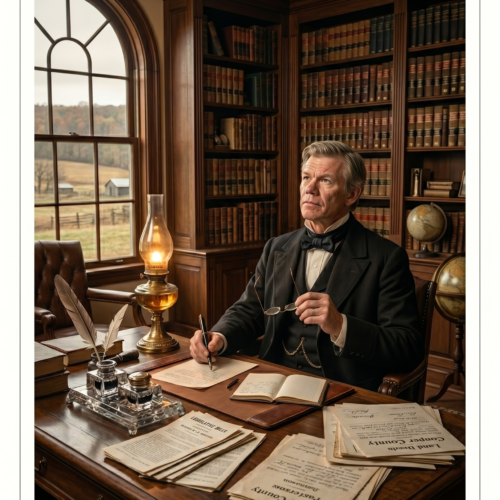
John Patterson, Sr. wasn’t a man who waited for things to happen. Born in Berks County, Pennsylvania, in 1760, he lived through the fire of the American Revolution. He served in the North Carolina Militia, a soldier of the Revolution who saw the birth of a nation. But even after the war, he wasn’t done.
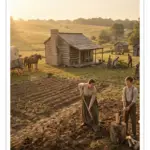
In 1797, while Missouri was still under Spanish rule and the United States was just a collection of states on the East Coast, John packed up his wife, Kezia Hornaday, and their children. They trekked through Kentucky and crossed the Mississippi, arriving in the Florissant valley when it was nothing but ancient trees and tall grass.
They built the Cold Water Settlement. They weren’t just farmers; they were the “Gatekeepers” of the frontier. John became a “Syndic,” a local leader appointed to keep order. And right there, on the banks of Cold Water Creek, they started a family cemetery that would eventually become the oldest Protestant burial ground west of the Mississippi.
Every time I hung out in Florissant as a teenager, I was literally walking on the kingdom John and Kezia built.
Smashing the “Brick Wall”
For a while, my research was stuck. I knew my grandma lived in Florissant. I knew her father was William Turner Patterson, born in 1880. But how did I get from a 1760 Revolutionary hero to the man I saw in the 1930 census?
I felt like I was looking for a needle in a haystack of Williams. I found an 1880 census with a James and Elizabeth Patterson, and there, tucked into the household, was a 22-year-old William. That was the “Eureka” moment. That William (b. 1858) was the bridge. He was the son of James William A. Patterson (b. 1808) and the grandson of the original William (b. 1785).
Suddenly, the line was unbroken:
-
John (the Veteran)
-
William (the Pioneer)
-
James (the Bridge)
-
William (the Father)
-
William Turner (my Great-Grandfather)
-
My Grandma
-
My Dad
-
Me.
The “Brick Wall” didn’t just fall; it turned into a staircase.
The Call to the DAR
Because I am a direct descendant of John Patterson, I have a “proven line” to the American Revolution. But more importantly, I have a connection to the Cold Water Cemetery.
The cemetery is private, protected by the Daughters of the American Revolution (MSSDAR). I have officially reached out to request a walkthrough. I want to stand at the graves of John and Kezia. I want to tell the DAR that I’m not just a researcher—I’m a daughter of the soil. I grew up in North St. Louis, I hung out in Florissant, and I am ready to take my place in the story of this land.
Asking to be a “Daughter” of the Revolution isn’t about vanity. It’s about ensuring that when people drive down Patterson Road, they know it isn’t just a name. It’s a legacy of service, survival, and a family that refused to let the wilderness win.
The DNA Reveal: The Final Proof
In about two weeks, my DNA results will land in my inbox. For some people, it’s about seeing if they are 10% Irish or 5% French. For me, it’s about the Matches.
I am looking for the Hornaday cousins from Pennsylvania and North Carolina. I am looking for the Allen and Turner descendants who stayed in Missouri. I want to see the genetic proof that the stories my grandma told me were 100% real. When those results drop, I’ll be sharing the reveal on the blog. It will be the final “stamp” on a journey that has taken me from the archives to the very streets I’ve lived on my whole life.
Why We Sift
We “sift through the soil” because we don’t want to be ghosts in our own lives. We want to know why we are the way we are. Why did my family stay in North County for over 200 years? Why did my dad live in Florissant? Why did my grandma hold onto those stories so tightly?
It’s because we belong here.
The next time I drive down Patterson Road, I’m not just going to see an intersection. I’m going to see a monument. I’m going to see a family that fought for the right to be there. And I’m going to know that every time I “hung out” in Florissant, I was exactly where I was meant to be.
The gates of Cold Water are waiting. My ancestors are waiting. And the soil is ready to tell the rest of the story.
Post Disclaimer
Disclaimer This blog is a personal project and is for informational purposes only. It is not intended to serve as a definitive legal or historical record for anyone other than myself.


Wow that’s amazing! Next chapter please…