In the quiet hours of research, when the modern world fades away and the glow of the screen becomes a window into the past, I found them. They are the bedrock. They are the two figures standing at the very edge of my known history, representing the moment two vastly different worlds collided and merged to create the lineage I carry today.
They are Walter Isaac Labon, known to the frontier as “Trader Labon,” and the woman whose name echoes with the power of the earth itself: Nancy Black Fox.
As I write my memoir and piece together the fragments of the Powell and Burgdorf lines, I keep returning to this 18th-century union. To understand who I am, I have to understand the bridge they built in the untamed wilds of the American Southeast.
The Highlander in the Hollows
The story begins with a man who likely spoke with the thick, rolling burr of the Scottish Highlands. Walter Isaac Labon was born around 1706, a time when Scotland was a place of political upheaval and economic struggle. For a young man with nothing but his name, the American colonies offered a dangerous but glittering promise.
But Walter didn’t settle for the coastal cities of the East. He didn’t want a tidy plot of land in a colonial village. Instead, he pushed west, crossing the “fall line” into the interior of what we now call Alabama and Mississippi. He became a Licensed Trader.
In the 1720s, being a trader was a role of immense complexity. You weren’t just a salesman; you were a diplomat, a linguist, and a survivor. Walter would have traveled the ancient trails with packhorses laden with European goods—wool blankets, iron kettles, and knives—trading them for the deerskins that fueled the global economy of the time. To do this successfully, he had to live among the Indigenous Nations. He had to learn their languages, respect their laws, and, eventually, become part of their kinship circles.
The Legend of Nancy Black Fox
Deep in the heart of this “Middle Ground,” Walter met Nancy. Born around 1705, Nancy Black Fox is a figure who exists at the intersection of history and spiritual legacy. Her name, Black Fox, carries deep weight. In the Cherokee and Chickasaw traditions, names were not just labels; they were reflections of character, clan, and spirit.
Nancy is often identified through oral histories and early colonial records as being of Chickasaw or Cherokee descent. In the early 18th century, these nations were not the “displaced” peoples we read about in later history books. They were sovereign, sophisticated, and powerful. They controlled the river valleys and the trade routes.
When Nancy and Walter Isaac Labon came together around 1725, it was more than a marriage. In the eyes of the tribe, it was a strategic alliance. For Walter, marrying Nancy meant he was no longer an outsider or a “vulnerable” European; he was a husband and a kinsman. He gained the protection of her people. For Nancy, this union placed her at the center of the changing world, acting as a bridge between her ancestral traditions and the encroaching tide of European trade.
Life in the Chickasaw Shadows
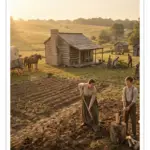
I try to imagine their daily life. It wasn’t the life of a pioneer in a log cabin with a white picket fence. It was a life lived in the rhythm of the seasons and the demands of the trade. They likely lived in or near the Chickasaw villages in the region that would later become Mobile or the Tennessee River Valley.

Their home would have been a hub of activity. Imagine the smell of woodsmoke and curing hides, the sound of multiple languages—Muskogean, English, French, and Gaelic—mingling in the air. This was the environment where my 7th great-grandmother, Sarah Malea Labon, was born in 1725.
Sarah was the embodiment of this New World. She was the daughter of a Scotsman who had crossed an ocean and a woman who belonged to the very soil of the continent. She was born into a world where she had to navigate two identities, a theme that I find myself exploring deeply in my own writing today.
The Echo of the Black Fox
As a genealogist, I am constantly “sifting” through the soil of these records, and I have to acknowledge the mystery that surrounds a name like Black Fox.
In the late 18th century, there was a famous Cherokee Principal Chief named Enoli, or Black Fox. While Nancy lived decades before him, the recurrence of this name in our family tree suggests a deep-rooted clan affiliation. The Black Fox was a figure of cunning and resilience. To find this name in my own bloodline is a reminder that our ancestors weren’t just “names on a page”—they were people of status, leaders, and survivors of a world that was rapidly shifting beneath their feet.
The location often associated with Nancy’s birth and death—Cullman, Alabama—is a modern marker for an ancient place. Long before the city of Cullman was founded by German immigrants in the 1800s, those hills and valleys were the hunting grounds and homes of Nancy’s people. When I look at a map of Alabama today, I don’t just see counties and highways; I see the landscape where Nancy and Walter walked, traded, and raised the children who would eventually lead to me.
Why Their Story Matters Now
In my memoir, I talk a lot about the “unspoken” parts of our history. For generations, many families in the South hid or “quieted” their Indigenous heritage. It was often safer to claim a “Black Dutch” or “Mediterranean” grandmother than to admit to Native blood during the eras of removal and Jim Crow.
But as I sift through the soil in 2026, the truth is rising to the surface. Finding Nancy Black Fox and Trader Labon feels like a homecoming. It validates the stories that were whispered down through the generations. It explains the restless, pioneering spirit that drove our family from the banks of the Mobile River up into North Carolina and eventually back into the heart of the South.
Walter Isaac Labon brought the tenacity of the Scot; Nancy Black Fox brought the ancient wisdom and connection to the American land. Their union produced Sarah Malea Labon, who carried that dual legacy forward into the families that would eventually become my own.
The Search Continues
Every time I find a new record—a mention of a “Trader Labon” in a colonial ledger or a reference to the Black Fox lineage in a tribal history—I feel a physical jolt of connection. These aren’t just “interesting facts.” These are the reasons I am here.
I am currently waiting on DNA results to see how these ancient stories manifest in my own biology. Will I see the markers of the Southeastern tribes? Will I see the genetic map of the Scottish Highlands? Regardless of what the science says, the history is clear.
Nancy and Walter were the pioneers of our family’s identity. They lived in a world where the rules were being written as they went along. They chose each other, they survived the frontier, and they planted the seeds for a family tree that has spanned three centuries and thousands of miles.
As I continue to write Sifting Through the Soil, Nancy and Walter will be the guardians of the early chapters. They remind me that we are all made of stories—some written in ink, some written in blood, and some whispered by the wind through the pines of the Alabama wilderness.
Author’s Note: This discovery has changed the way I look at my research. If you are also tracing the Labon or Black Fox lines, I would love to hear from you. We are all sifting through this same soil together.
Sources & Further Reading
-
Historical Context: Verner Crane’s The Southern Frontier, 1670-1732 provides a detailed look at the world of licensed Indian traders in the 18th century.
-
Primary Records: You can browse historical records of the Southern frontier via the Internet Archive to see maps and trade ledgers from this era.
-
Tribal History: For more on the legacy and culture of our ancestors’ people, visit the official history of the Chickasaw Nation.
-
Leadership Lineage: Explore the Cherokee Principal Chiefs to learn more about the significance of the Black Fox name.
Post Disclaimer
Disclaimer This blog is a personal project and is for informational purposes only. It is not intended to serve as a definitive legal or historical record for anyone other than myself.

Leave a Reply